What Is Chainlink (LINK)? How Crypto Oracles Work
Educational content · reviewed for accuracy · not financial advice
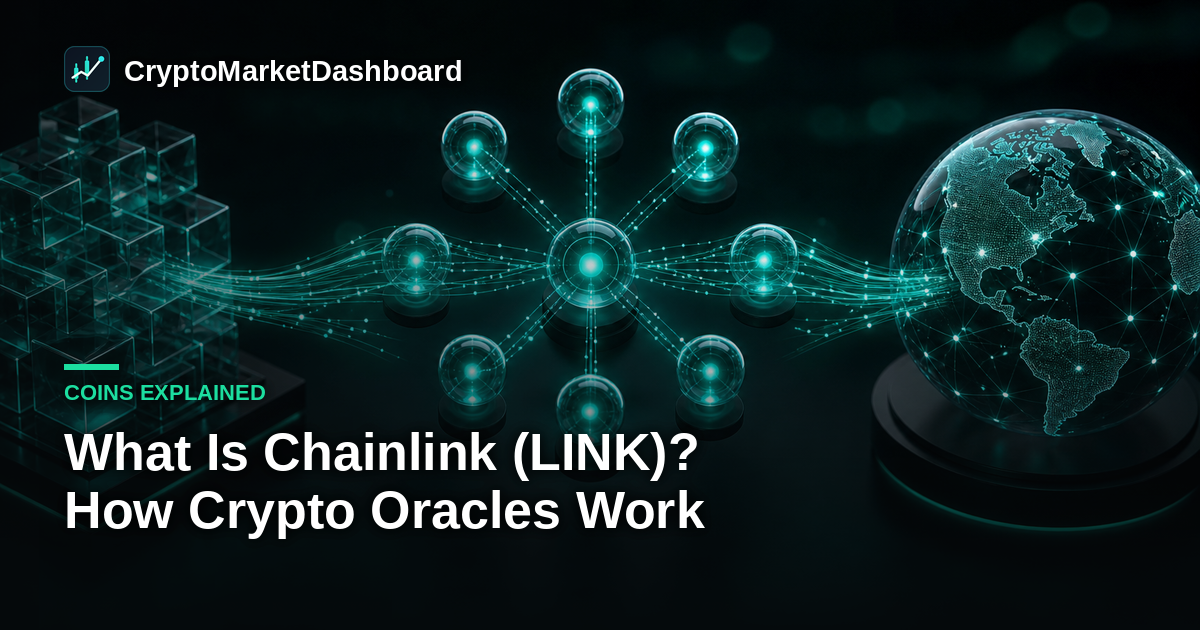
Chainlink is a decentralized oracle network that connects smart contracts to external real-world data — prices, weather readings, sports results, and more. LINK is the token used to pay node operators who fetch and deliver this data on-chain.
Live price right now
Prices update automatically every minute · data from CoinMarketCap.
On this pagetoggle
The Problem: Blockchains Cannot See the Outside World
Blockchains are designed to be deterministic. Every node in the network runs the same code and must arrive at the same result. That is what makes them trustworthy — but it also creates a hard limitation: a blockchain cannot, by itself, reach out to the internet and fetch live data.
Think about what that means in practice. A DeFi lending protocol needs to know the current price of ETH to decide whether a loan has become undercollateralized. An on-chain insurance contract needs weather data to trigger a payout. A prediction market needs an election result to settle correctly. None of this information lives on the blockchain.
Smart contracts execute automatically when conditions are met — but those conditions can only reference data that already exists on-chain. This gap between blockchain logic and the real world is called 'the oracle problem.' Without a reliable solution, entire categories of decentralized applications become impossible to build safely.
What Is a Crypto Oracle?
An oracle is any service that fetches external data and delivers it to a smart contract on-chain. The concept sounds straightforward, but the execution is where most approaches fail badly.
A centralized oracle — one company, one API, one data source — is a single point of failure. If that provider is compromised, manipulated, or goes offline, every smart contract relying on it becomes vulnerable. DeFi protocols have lost tens of millions of dollars to price oracle manipulation attacks, where an attacker briefly moved a price on a thin exchange to trick an oracle into reporting a false value, then exploited the resulting mispricing to drain funds.
The solution requires the same design principle blockchains themselves use: decentralization.
How Chainlink Works: Decentralized Oracle Networks
Chainlink's core innovation is the Decentralized Oracle Network, or DON. Rather than relying on a single data source, a DON uses multiple independent node operators who each fetch the same data separately from multiple sources, then aggregate those results into a single reliable answer.
Here is how a typical Chainlink price feed works step by step:
Multiple node operators — run by professional data providers, blockchain infrastructure companies, and independent operators — each query several data sources for the same price. Each node signs its result cryptographically and submits it to an on-chain aggregator contract. The aggregator computes the median or weighted average, discarding outliers. The final figure is what gets published as the canonical price.
To ensure honest behavior, Chainlink requires node operators to stake LINK tokens as collateral. If a node submits data that deviates significantly from the consensus, it can be penalized — a mechanism called slashing. This economic stake aligns node operators' incentives with accuracy: cheating costs them real money.
Data consumers — the protocols and applications that read Chainlink data — pay for this service in LINK.
A Brief History
Chainlink was founded by Sergey Nazarov and Steve Ellis. The project published its whitepaper in 2017 and launched on Ethereum mainnet in 2019. It was one of the first serious, production-grade attempts to solve the oracle problem at scale.
Since then, Chainlink has expanded far beyond Ethereum. It now operates across dozens of blockchains including Solana, Avalanche, Polygon, BNB Chain, Arbitrum, and more — making it effectively blockchain-agnostic infrastructure rather than an Ethereum-only project.
Chainlink's Core Products
Price Feeds
Chainlink's most widely used product. There are over 1,000 price feeds covering token pairs, foreign exchange rates, and commodities like gold and silver. Major DeFi protocols including Aave, Synthetix, and dYdX rely on Chainlink price feeds to power lending, derivatives, and synthetic asset platforms. If a protocol needs to know the ETH/USD rate at any given moment, Chainlink Price Feeds are the default choice in most of the industry.
Data Streams
A low-latency data delivery product designed for high-frequency trading applications that need price updates measured in milliseconds rather than in the seconds or minutes typical of standard on-chain feeds. Standard feeds update at fixed intervals or price deviation thresholds; Data Streams push updates far more frequently for applications where that speed matters.
VRF — Verifiable Random Function
On-chain randomness sounds simple but is genuinely difficult to do fairly. Validators and miners can see upcoming block hashes and potentially manipulate 'random' outcomes in their favor. Chainlink VRF generates cryptographically provable randomness that cannot be manipulated by any single party — including Chainlink itself. This makes it the standard solution for NFT drops requiring fair rarity distribution, blockchain games with random loot, and on-chain lotteries where participants need proof the draw was not rigged.
Proof of Reserve
As real-world assets get tokenized — wrapped Bitcoin, tokenized Treasury bills, stablecoin reserves — there is a need to verify that the on-chain token is actually backed by the claimed off-chain asset. Chainlink Proof of Reserve provides automated, on-chain verification of these reserves, reducing reliance on self-reported audits that could conceal shortfalls.
CCIP — Cross-Chain Interoperability Protocol
One of Chainlink's newer and most ambitious products. CCIP is a standard for secure messaging and token transfers between different blockchains. Rather than each bridge project rolling its own security model — with often disastrous results, given that cross-chain bridge hacks have cost the industry billions of dollars — CCIP provides a common, extensively audited infrastructure layer. SWIFT, the global interbank messaging network, partnered with Chainlink to test CCIP for settlement using tokenized assets, signaling serious enterprise interest.
The LINK Token
LINK is an ERC-20 token on Ethereum, with representations on other chains. Within the Chainlink network, it serves two distinct functions.
Payment: data consumers pay node operators in LINK for retrieving and delivering accurate data to their smart contracts.
Staking collateral: node operators must stake LINK to participate in high-security data feeds. Stakers who provide accurate data earn staking rewards; those who deviate from consensus risk having their staked LINK slashed.
Chainlink introduced a community staking mechanism in late 2022 and expanded its capacity in subsequent years, allowing LINK holders who are not node operators to also stake, earn rewards, and contribute to network security alerts. You can track the live LINK price and compare it against other cryptocurrency prices to put its current valuation in context.
Who Uses Chainlink?
The breadth of Chainlink adoption is one of its most significant characteristics. On the DeFi side: Aave, Compound, Synthetix, dYdX, MakerDAO, and hundreds of smaller protocols depend on Chainlink data feeds. The total value of DeFi activity secured by Chainlink data is measured in hundreds of billions of dollars across its history — making it infrastructure at a scale few Web3 projects have matched.
Outside DeFi: insurance protocols use Chainlink data for parametric payouts triggered automatically by weather conditions or flight delays. NFT projects use Chainlink VRF for provably fair minting and trait assignment. Gaming applications use VRF for loot drops and match outcomes. Enterprise clients including SWIFT and several central banks exploring tokenized asset settlement are actively evaluating CCIP.
Risks and Honest Assessment
Chainlink has achieved something rare in crypto: it has become genuine infrastructure. Like AWS for cloud computing or Stripe for payments, Chainlink operates largely in the background of Web3 — essential to the applications built on top of it, but invisible to end users.
Infrastructure status does not automatically make LINK a simple investment in that infrastructure's growth. Several honest concerns deserve acknowledgment.
Token value accrual is debated. The relationship between Chainlink's data volumes, fee revenue, and LINK token price is not straightforward. Node operators can receive payment structured in various ways; Chainlink Labs can adjust fee structures over time. Whether LINK captures value proportional to the network's usage is a genuinely open question that reasonable analysts disagree on.
Centralization risk remains real. Chainlink Labs, the company, retains significant influence over node selection, product development, and network parameters. The node set, while expanding, includes a number of well-known professional operators with publicly identifiable entities behind them. This is meaningfully more decentralized than a single oracle, but it is not the fully permissionless, trust-minimized model the whitepaper's long-term vision describes. Full decentralization is a stated goal, not a current reality.
Competitors are gaining ground. Pyth Network has grown rapidly on Solana and for high-frequency trading use cases. UMA's Optimistic Oracle takes a different design approach. CCIP competes with established bridge protocols that have their own user bases and liquidity.
None of this negates Chainlink's track record. For production DeFi protocols building on Ethereum and its ecosystem, Chainlink remains the default choice for reliable, decentralized data — and defaults that are embedded deeply in production code are hard to displace even when alternatives improve.
This article is for educational purposes only and is not financial advice. Cryptocurrency markets are highly volatile and unregulated in many jurisdictions. Always do your own research and consult a qualified financial adviser before investing.
Frequently asked questions
What is Chainlink in simple terms?+
Chainlink is a decentralized network of data providers that fetches real-world information — like asset prices, weather data, or sports results — and delivers it reliably to smart contracts on the blockchain. It solves the core problem that blockchains cannot access the internet on their own.
What is an oracle in crypto?+
A crypto oracle is any service that connects a blockchain to external data sources. Because blockchains are closed systems that cannot natively fetch outside information, smart contracts need oracles to access things like current prices, event outcomes, or sensor readings. The risk with a single centralized oracle is that it becomes a point of failure or manipulation — which is why decentralized oracle networks like Chainlink use multiple independent data sources.
What is LINK used for?+
LINK serves two roles in the Chainlink network. First, it is the payment token: applications that consume data from Chainlink pay node operators in LINK. Second, it is the collateral token: node operators must stake LINK to participate in data feeds, and they risk losing staked LINK through slashing if they submit inaccurate data.
Why does DeFi need Chainlink?+
DeFi protocols need accurate, real-time price data to function safely. A lending platform must know the current value of collateral to trigger liquidations before a position goes underwater. A synthetic asset platform needs reliable price feeds to mint and redeem assets correctly. Without trustworthy oracle data, these protocols are vulnerable to price manipulation attacks that can drain user funds.
Is Chainlink a good investment?+
Whether LINK suits your portfolio depends on your risk tolerance, time horizon, and view on the token's value accrual from network fees. Chainlink is genuine infrastructure for Web3, but the connection between usage growth and LINK price appreciation is not guaranteed or straightforward. LINK is a volatile asset. This is not financial advice — always conduct your own research and consider consulting a financial adviser before making any investment decision.
Our editorial team covers cryptocurrency market data, on-chain metrics and beginner education. Every guide is fact-checked against live market data from CoinMarketCap and Binance and reviewed for accuracy. Content is educational only and not financial advice. Learn about our data & methodology →
Track the market live
Real-time prices, market cap and trends for the top 100 coins.